
Fewer Keys, More Villas: How Morocco’s Ultra-Luxury Hotels Are Rewriting the Revenue Model


From Royal Mansour to the planned Anantara Retreat Rabat, Morocco’s luxury market is exploring a different equation: fewer conventional rooms, more private space, richer guest spend, and new ways to finance hospitality.
By Peter Manshoven | Peter.ma Travel Intelligence
Morocco’s luxury-hospitality landscape is not moving in one uniform direction. But across a selection of established resorts and announced developments, a clear strategy is visible: private villas, branded residences, wellness, gastronomy, and destination experiences are becoming more central to the product.
The latest signal comes from Rabat. In October 2026, Minor Hotels announced the signing of Anantara Retreat Rabat with Abu Dhabi-based developer Bloom Holding. The planned property is expected to open in early 2030 in the capital’s diplomatic district. It is designed to have 38 keys, including seven three-bedroom villas. This remains an announced development, not an operating hotel; rates and booking details have not been released.
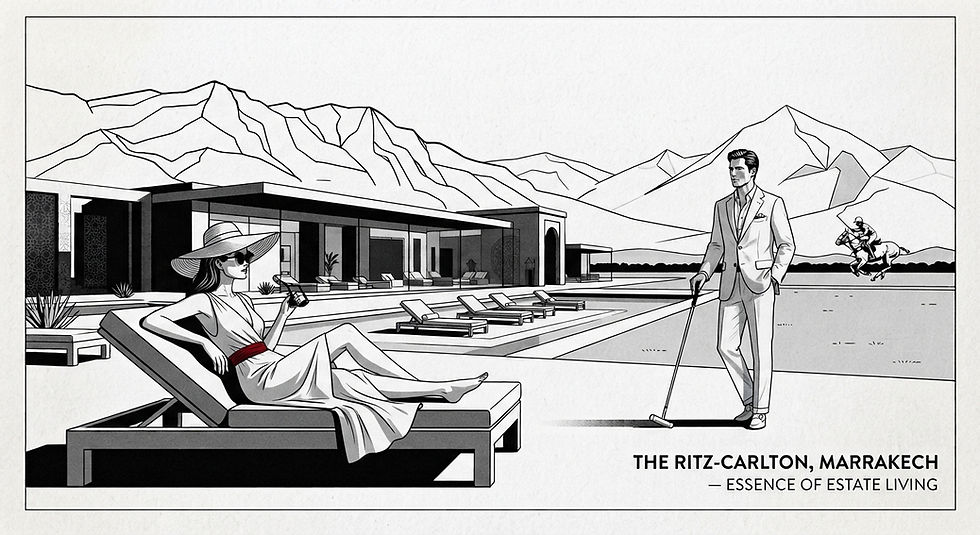
In Marrakech, the Ritz-Carlton Residences and Resort illustrates a different approach. According to financial adviser Ento Capital’s project report, the project combines a hotel of 60 suites and 20 hotel villas with 85 residential villas of three to five bedrooms, in a development valued at more than USD 220 million. The residential villas outnumber the hotel’s accommodation units.
These projects are not identical, and they do not by themselves prove that villas are more profitable than conventional rooms. They do, however, reveal a strategic question for owners and operators: how can a luxury property generate more value from each stay, each unit, and each dirham of invested capital?
Scope note: This is an indicative selection of established properties and announced projects, not a complete inventory of Morocco’s villa-led luxury market. Planned developments are described as plans, not as completed or financially proven operations.
The reference model of Morocco’s Ultra-Luxury Hotels: Royal Mansour
Royal Mansour Marrakech helped establish the private-riad proposition at the top end of the market. Opened in 2010, it replaced the conventional hotel-room experience with 53 private, three-storey riads inside a walled medina. Each has its own entrance, courtyard, and roof terrace, with a plunge pool and butler service. Its proposition is built around privacy, craftsmanship, space, and intensive service rather than room volume.
The group has extended this approach to the coast. Royal Mansour Tamuda Bay is the third address in the collection after Marrakech and Casablanca. National Geographic’s hotel profile counts 55 villas and suites, all with butler service. The resort occupies about 10 hectares on the Mediterranean coast, with a 4,300-square-metre Medi-Spa and four restaurants. Further property details provide additional context.
The commercial logic is broader than accommodation. Private dining, wellness, gastronomy, and coastal experiences can add revenue to a high-value stay. Whether they add profit depends on demand, pricing, and the cost of delivering them.
From palace riads to villa-led resorts
The villa-plus-hotel concept is not new. What varies is the role villas play in the overall business model. In some properties, a villa is a premium category within a conventional hotel. In others, private accommodation defines the guest proposition, while the hotel provides the service infrastructure around it.
Two Marrakech examples
The Oberoi, Marrakech is close to an all-villa resort in feel, although its inventory includes different accommodation types. Opening coverage reported that 76 of its 84 rooms, suites, and villas have large private pools and gardens. The hotel’s official website presents a range of villas, including a Royal Villa with two bedrooms, separate living and dining areas, a kitchen, and a large private pool. Breakfast, return airport transfers, and butler service form part of the offer described for relevant stays. Esquire Middle East’s opening coverage provides additional context.
Four Seasons Resort Marrakech represents a hybrid model. It combines a 141-key hotel with garden villas and private residences. Its four-bedroom Royal Villa is designed for families and groups, with a private pool and additional services. A group can book one multi-bedroom home rather than several separate rooms. That may increase the value of a single booking and concentrate spending around one party, although the financial outcome depends on the rate, occupancy, and cost structure.
Es Saadi Palace offers another established hybrid, pairing hotel rooms and suites with private villas and ksars.
Residences and the development pipeline
The Ritz-Carlton Residences and Resort Marrakech sits on roughly 50 hectares along the Amezmiz road and is anchored by polo. Project and auction background provides information on the residential component.
Delano Marrakech Hotel & Residences was announced by Ennismore and YAMED. The plan includes 130 guestrooms, suites, and private villas, plus about 80 branded residences described as villas of four to six bedrooms. It is an announced project, so its planned inventory should not be confused with operating capacity. Travel Daily News’ project coverage outlines the development.
Anantara Retreat Rabat takes a more compact approach. Its announced 38-key plan includes seven three-bedroom villas, positioning it as an intimate retreat in the capital rather than a large residential resort. Minor Hotels’ announcement sets out the project as planned.
A perfect example of the new generation of Morocco's Ultra-Luxury Hotels.
Property or project | Model described | Strategic signal |
Royal Mansour Marrakech | 53 private riads | Privacy and service as the core product |
Royal Mansour Tamuda Bay | 55 suites and villas, butler service, and Medi-Spa | Private accommodation in a coastal resort |
The Oberoi, Marrakech | 84 accommodation units; opening coverage reported 76 with private pools and gardens | A resort where private outdoor space is central |
Four Seasons Resort Marrakech | 141 hotel keys plus garden villas and residences | Conventional hotel services combined with group-sized accommodation |
Es Saadi Palace | Hotel and suites plus villas and ksars | An established hybrid model |
Ritz-Carlton Residences and Resort Marrakech | Reported 80 hotel units plus 85 residential villas | Hotel and residential real estate in one development |
Delano Marrakech (planned) | 130 rooms, suites, and villas plus about 80 branded residences | Lifestyle hospitality linked to residential sales |
Anantara Retreat Rabat (planned for early 2030) | 38 keys, including seven three-bedroom villas | Compact luxury positioning in the capital |
The figures describe different types of inventory and different project stages. Hotel keys, hotel villas, and privately owned residences are not interchangeable units, and the table should not be read as a like-for-like financial comparison.
Why fewer keys can mean more revenue — but not automatically more profit
The goal is not simply to maximise occupancy. It is to improve the quality of revenue while controlling the cost of delivering the guest experience. Five measures help explain the commercial logic:
ADR (Average Daily Rate): A villa is often priced as a private unit for a family or group, rather than as a single bed. Its total nightly rate may be higher than that of a standard room, but comparisons need to account for capacity, occupancy, seasonality, and the number of guests.
TRevPAR (Total Revenue per Available Room): Unlike room-only RevPAR, TRevPAR includes revenue from food and beverage, spa, transfers, experiences, retail, and events. A villa stay may create more opportunities for private dining, hammam treatments, chauffeurs, celebrations, and activities. Whether that translates into a stronger result depends on actual spending and the costs required to serve it.
TRevPOR (Total Revenue per Occupied Room): This measures total revenue per occupied room or unit. A single occupied villa may accommodate several guests and generate multiple restaurant covers, spa bookings, and excursions. The operator has the opportunity to serve the whole party, not just sell accommodation.
NRevPAR (Net Revenue per Available Room): This can help assess room revenue after specified distribution and transaction costs, but definitions vary. Any analysis should state exactly which commissions and costs are deducted. For illustration, a villa night sold for MAD 10,000 with a 20% commission would incur MAD 2,000 in commission before other costs. That is a scenario, not a claim about typical commission levels; direct bookings also carry acquisition and servicing costs.
GOPPAR (Gross Operating Profit per Available Room): Butlers, private pools, gardens, security, and personalised service can be expensive. GOPPAR helps assess whether pricing and ancillary revenue cover operating costs and produce stronger operating profit per available room.
A further measure is flow-through: how much of each additional dirham of revenue reaches operating profit after the extra costs of delivering it. That matters in a villa-led operation, where a higher rate may come with more labour, maintenance, energy, and service requirements.
The conclusion is not that villas always win. It is that a villa-led model can create more value per booking and per available unit when pricing, occupancy, ancillary spending, and operating costs work together.
The residential layer: a capital-stack tool
Branded residences add a second business model to the hotel operation. Selling villas or apartments before completion can bring staged payments into a development and reduce the amount of capital the developer must finance at peak construction. Depending on the deal structure, residence sales may improve project funding and change the risk profile.
They do not automatically reduce total development cost, guarantee bankability, or make the hotel more profitable. The outcome depends on land and infrastructure costs, sales prices, financing terms, construction obligations, brand and management agreements, and the rights granted to owners.
The Ritz-Carlton Residences Marrakech illustrates the residential dimension. Tempus Magazine reported that the first phase launched in April 2018 and that 65% of the villas sold soon afterwards. Buyers were offered benefits including polo-club membership and access to the Ritz-Carlton Privilege Card. See Tempus Magazine’s project coverage. Ento Capital later announced an advisory agreement connected with the project, covered by Financial Afrik.
Other branded-residence and hotel-villa concepts are also being developed in Morocco, including the announced Delano Marrakech project. Each scheme must be assessed on its own ownership, financing, and operating structure.
A branded residence is not necessarily owned, developed, or sold by the hotel brand whose name it carries. The marketing notice for the Ritz-Carlton Residences makes that distinction explicit. Buyers and investors should examine who owns the real estate, who operates the hotel, who manages the residences, how rental programmes work, and which services are guaranteed. Concierge Auctions’ project notice is a useful reference.
How the product is marketed
These properties sell more than a place to sleep. They sell a private Moroccan stay:
A private riad or villa rather than a conventional room
A dedicated entrance, pool, garden, and terrace
Butler service, private dining, and discreet assistance
Moroccan craftsmanship, courtyards, and hammam
Family stays, celebrations, wellness, sport, and longer visits
Where relevant, a residential community connected to hotel services
The Oberoi places private pools and gardens at the centre of much of its accommodation offer. Four Seasons combines a full-service hotel with a serviced home for families and groups. Royal Mansour makes privacy and the riad itself the defining experience.
Potential segments include European luxury travellers, Gulf and other Middle Eastern families, affluent Moroccan guests and diaspora, diplomatic and corporate travellers, and buyers seeking a second home with hospitality services. These are plausible target groups based on the product and location, not measured market-share findings. Rabat’s diplomatic setting makes corporate and diplomatic demand a relevant positioning hypothesis for the planned Anantara retreat, but its actual customer mix remains to be seen.
Why Morocco fits
Morocco already has the cultural and architectural vocabulary for private, low-density luxury: the riad, courtyard, garden, hammam, and roof terrace. Royal Mansour demonstrates how these elements can be translated into an internationally positioned luxury product.
The wider tourism market provides important context. Morocco received 19.8 million visitors in 2025, up 14% year on year, while tourism receipts reached MAD 138 billion, up 21%, according to the Ministry of Tourism. See the official tourism statistics.
Receipts growing faster than arrivals is consistent with an increase in the value generated by tourism overall. It does not, on its own, prove that demand for ultra-luxury villas is growing at the same rate. That conclusion would require more specific evidence on luxury-hotel performance, achieved rates, occupancy, and guest spending.
The national strategy aims to improve the visitor experience, upgrade accommodation, and diversify the tourism offer, with an ambition of 26 million tourists by 2030. Against that backdrop, villa-led properties are one possible way to compete on value and experience rather than bed count alone.
The settings offer distinct propositions: gardens, palm groves, and Atlas views around Marrakech; Mediterranean frontage at Tamuda Bay; and the diplomatic and cultural setting of Rabat. Their commercial potential will depend on each destination’s demand, access, seasonality, competitive set, and operating model.
The new luxury equation
Higher+valuestays+ancillaryspending+controlledservicecosts+capitaldiscipline=potential for stronger operating returns
Royal Mansour demonstrates the established private-riad model in Marrakech and its extension to the coast. The Oberoi and Four Seasons illustrate different ways of integrating private accommodation into full-service resorts. The Ritz-Carlton Residences and the planned Delano and Anantara projects show how the relationship between hotels, villas, and residential real estate continues to evolve.
The models are not identical, and the financial outcomes are not guaranteed. But the strategic direction is worth watching: in Morocco’s ultra-luxury market, the competition is increasingly about the value of the stay, the privacy of the product, and the economics behind each unit — not simply the number of keys.
The future of Moroccan ultra-luxury may be fewer conventional keys, more private space, and a closer relationship between hospitality and residential real estate. The winners will be those who turn that proposition into sustainable operating profit.
Sources & Further Reading
The following sources support the factual background and project descriptions. Links to key sources are also included in the relevant sections above.
Minor Hotels — Anantara Retreat Rabat announcement (October 2026)
Ministry of Tourism, Morocco — Key tourism figures for 2025
Gulf Daily News — Ento Capital and the Ritz-Carlton Residences Marrakech project
Financial Afrik — Ento Capital advisory agreement related to the Marrakech hotel project (January 2024)
Tempus Magazine — Ritz-Carlton Residences Marrakech
Concierge Auctions — Ritz-Carlton Residences Marrakech project notice
Travel Daily News — Delano Marrakech Hotel & Residences project
The Oberoi Hotels & Resorts — Official Marrakech property page
Esquire Middle East — Oberoi Marrakech opening coverage
National Geographic — Royal Mansour Tamuda Bay
Staysomedays — Royal Mansour Tamuda Bay property details
Editorial note: Project details, inventory figures, and market statistics are based on the sources cited and may change. Planned projects are identified as such; financial outcomes are analysis, not guarantees. Readers are encouraged to consult the original sources for the latest information.
Peter Time for a T.

Comments