
The Ritz-Carlton, Marrakech: When the Resort Becomes the Destination — The Marrakech Luxury Paradox

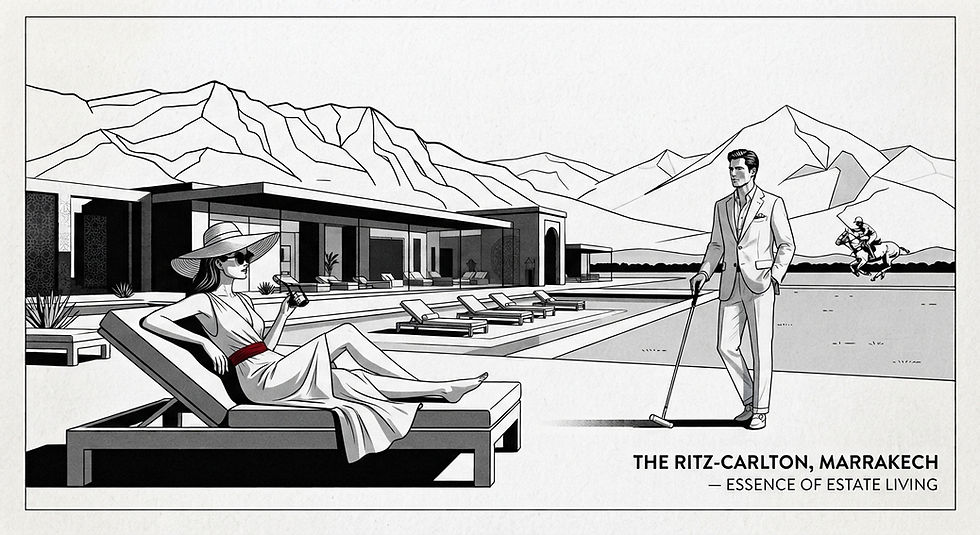
Marrakech is adding another ultra-luxury layer with The Ritz-Carlton, Marrakech—a 50-hectare polo-led resort with hotel, villas, and branded residences on the city's outskirts. On paper, it is a compelling concept: space, privacy, equestrian life, and a globally recognized brand. In practice, it lands in a market where luxury supply is growing faster than the “perfect season” it once relied on.
The real question is no longer whether Marrakech is attractive. It is whether a new, isolated, outdoor-heavy resort can justify its investment in a city where summer heat compresses the season, winters are becoming less predictable, and the urban vibe is no longer the main product once you move outside the medina.
The 50-hectare estate combines polo fields, landscaped gardens, and Atlas Mountain views. Images: Icon Private Collection.
A project that reveals the new Marrakech math.
The Ritz-Carlton, Marrakech is designed as more than a hotel. In January 2024, Ento Capital announced an agreement with Al Amal Investment Company (SIAMA) to advise on the development and management of the project, with a reported value exceeding US$220 million (approximately 2.19 billion MAD).
The estate sits along the Amezmiz road, around 20 minutes from central Marrakech, and covers nearly 50 hectares. It combines an 80-key Ritz-Carlton hotel (60 suites and 20 hotel villas) with fine-dining restaurants, a luxury spa, and landscaped gardens, plus a world-class polo club and 85 private residences in eight distinct styles.
Each residence features private terraces, en-suite bathrooms, expansive living areas, fully fitted kitchens, and separate dining spaces overlooking gardens, polo fields, and the Atlas Mountains. Villa owners can access Ritz-Carlton concierge, housekeeping, chauffeur, catering, childcare, and excursion services on demand.
By late 2026, Marriott was recruiting a General Manager with an anticipated opening in 2027, signaling that the project has moved from restructuring into active pre-opening.
On its own, this is a strong story: a reactivated, institutionally backed, branded resort with a clear identity. But viewed against Marrakech’s evolving market dynamics, it also becomes a lens for a wider question: how does ultra-luxury underwriting change when climate, supply, and location no longer line up as they once did?
From Rabat to Marrakech: Ritz-Carlton’s two-speed Morocco test
The Ritz-Carlton is already present in Morocco through its Rabat property, The Ritz-Carlton Rabat, Dar Es Salam, which opened in September 2024 with 117 keys (100 rooms and 17 suites) on a large forested estate.
Rabat is the political and administrative capital, with demand driven by government, diplomacy, corporate travel, and a smaller leisure segment. Marrakech, by contrast, is Morocco’s primary leisure and luxury destination, heavily dependent on tourism, second-home buyers, and seasonal visitors.
This creates a two-speed test for the brand in Morocco:
Rabat: A city-hotel/resort model where business, diplomatic, and MICE traffic can help smooth seasonality and support year-round occupancy. The product competes more on service, location, and corporate relationships than on resort-style amenities.
Marrakech: A resort-and-residences model where the core demand is leisure, highly seasonal, and climate-sensitive. The product must compete on estate living, polo, privacy, and a self-contained experience, with the city as an optional excursion.
For investors and observers, the Rabat property offers a reference point for how Ritz-Carlton performs in Morocco under more stable, urban conditions. The Marrakech project will test whether the same brand can succeed in a far more volatile environment: an over-supplied luxury market, a compressed high season, and a location that makes the resort itself the main attraction.
If Rabat demonstrates steady, city-driven performance and Marrakech struggles to fill a large, outdoor-led estate outside peak months, the lesson will be clear: the Ritz-Carlton brand alone is not enough. Success will depend on matching the product type to the city’s underlying demand structure and climate reality.
Over-supply in a climate-constrained season
Marrakech’s luxury inventory has expanded significantly over the last 15 years: historic palace hotels and grand properties in the medina and Hivernage; large international resorts in the Palmeraie and on the outskirts; a deep layer of high-end riads and boutique hotels; and now large-scale branded residence and resort projects like Ritz-Carlton.
Concrete capacity figures underline the scale. As of 2025, Marrakech had 1,934 classified tourist accommodations offering 75,026 beds. Since 2021 alone the city added 240 new establishments and 5,619 beds. Nationally, classified hotel capacity stood at just over 300,000 beds after recent expansion.
Demand is robust, but it is highly seasonal and source-market concentrated:
Peak: October–April (European, UK, US, some GCC).
Shoulder: May and September (heat begins to bite).
Deep low: June–August (extreme heat, limited MICE, weaker European demand; GCC is the main counter-season).
Recent performance numbers confirm both strength and seasonality. Morocco recorded a record 19.8 million tourist arrivals in 2025 (+14 % versus 2024).
Marrakech alone generated 13.66 million overnight stays in 2025 (+3 %), accounting for approximately 31 % of the national total, with an average occupancy rate of 73 % (up 2 points year-on-year).
Luxury and high-end properties in national samples showed occupancy gains (for example, rising from 58 % to 61 % in comparable periods) and stronger ADR/RevPAR growth than mid-scale segments, even as rates increased.
For large outdoor-led resorts, this matters because their economics rely on pool and garden usage, outdoor dining and events, and golf, polo, equestrian, and other open-air activities.
When daytime temperatures regularly exceed 40–45 °C in summer—the all-time station record at Marrakech-Ménara stands at 49.6 °C on 17 July 2012, and July average highs sit near 37–38 °C—the core experiential product is compromised. The result is a market where many luxury properties effectively operate a 10-month commercial season, with two months of deeply suppressed demand and/or rates.
In that context, ROI models that assume 12 months of strong performance are increasingly detached from reality. A more honest baseline for new ultra-luxury supply is:
7–8 months of high-ADR winter and early spring.
2 months of shoulder performance.
2–3 months where rates and/or occupancy are heavily discounted or supported by niche segments.
That structurally pushes realistic payback periods longer than the optimistic “10-month ROI” narratives sometimes seen in developer presentations.
Winter is no longer a guaranteed safe haven
Historically, Marrakech’s winter was marketed as near-perfect: dry, mild, sunny. Recent years have challenged that story. Guests and operators have experienced more frequent heavy rain episodes in winter, cooler-than-expected periods during what should be the core season, and greater year-to-year variability, with some winters very dry and others notably wet.
Climate data support the observation.
Morocco’s surface air temperature rose by approximately 0.43 °C per decade between 1971 and 2020, exceeding the global trend. The Mediterranean and North Africa are recognized as climate-change hotspots, with mean and seasonal temperatures increasing at roughly twice the global rate in many areas due to human-induced change.
Projections point to hotter summers (high confidence) and similar or slightly higher average winter rainfall, but with more intense precipitation events, higher risk of short disruptive flooding, and increased variability. Annual precipitation in Marrakech has historically averaged roughly 220–280 mm and remains highly variable from year to year.
For luxury resorts, this has two implications:
Revenue volatility in the core season. Heavy rain during key periods (Christmas, New Year, February half-term) can depress occupancy and ADR for those windows, even if demand shifts rather than disappears.
Perception risk over time. If several consecutive winters feel “unreliable,” the destination brand subtly shifts from “guaranteed winter sun” to “usually good, but check the forecast.” That weakens pricing power precisely where ultra-luxury properties need it most.
For an outdoor-heavy, polo-led resort, the combination of hotter summers and more variable winters means the “perfect season” is shrinking on both ends.
Outside the city: when isolation becomes the product
The Ritz-Carlton’s location is typical of a new generation of Marrakech projects: outside the dense urban fabric, on large land parcels where polo, golf, and extensive landscaping are possible.
This choice has clear advantages—space for polo fields, equestrian facilities, large gardens, and multiple pools; greater control over security, noise, service flow, and guest journey; and a narrative of privacy, exclusivity, and estate living attractive to HNWIs and residence buyers.
But it also changes the fundamental value proposition. In the medina or central districts, part of the hotel’s value is the city itself. Once you move outside, the story flips: the resort is the destination; the city is an optional day trip. That shift has three consequences:
The city becomes secondary. Marrakech moves from core product to excursion. The resort must generate enough internal gravity to justify multi-day stays without relying on urban energy.
Quality thresholds rise. A medina property can lean on the magic of its surroundings. An isolated resort cannot. If the architecture, landscape, F&B, spa, and programming are only “very good” rather than “memorable,” the lack of urban integration becomes a liability.
The competitive set widens. The resort no longer competes only with other Marrakech hotels. It competes with other large luxury resorts in Morocco and the region, international polo and equestrian destinations, and club-style and second-home environments where the “place” is the amenity mix, not the city.
In an over-supplied, climate-constrained market, only resorts with a clear, distinctive identity will sustain pricing and occupancy. “Another luxury box with a pool and a polo field” will be forced to compete on rate.
Residences are offered in eight distinct styles, each with private terraces and gardens.
Images: Icon Private Collection.
Interiors emphasize light, views, and indoor–outdoor flow, with fully fitted kitchens and separate dining areas. Images: Icon Private Collection.
What a realistic ROI model looks like now
Detailed financial terms for The Ritz-Carlton, Marrakech have not been made public. The analysis here therefore relies on reported project scale (US$220 million-plus, 50 hectares, 80 hotel keys + 85 residences), known market dynamics, and standard underwriting logic for ultra-luxury resorts, rather than on confidential investor models.
Given these dynamics, a credible underwriting framework for new ultra-luxury supply in Marrakech should:
Treat winter as high season but weather-sensitive, with a built-in downside scenario for occupancy and ADR in December–February.
Model three winter scenarios: good (dry, mild, strong ADR), average (some rain, minor disruptions), and bad (several heavy rain periods, some cancellations, lower ADR).
Assume a 10-month effective season within a 12-month year: 2 months of deep low season (summer heat) and some winter weeks underperforming due to weather.
Recognize that stabilized cash flow may only appear in year 4–6, depending on residence sell-out speed, brand ramp-up, and competitive discounting pressure.
In this light, claims of a very short payback (sometimes loosely described as “10-month ROI” in marketing materials) are only plausible if total investment is modest relative to cash flow, residence sales are treated as immediate profit that fully offsets hotel capex, and the model reflects a best-case rather than base-case scenario. A more conservative base case for a project of this scale and ambition would anticipate multi-year payback periods, with returns driven as much by residence values and brand equity as by pure hotel operating profit.
How The Ritz-Carlton can rewrite the equation
For a luxury brand like Ritz-Carlton, the starting point is not to fight the market’s structural constraints, but to design around them. The simplest and most effective lever is financial, not experiential: accept that overhead will be high, and use pricing and cost architecture to keep the whole operation in balance.
Treat high overhead as a feature, not a bug. A polo-led, low-density estate with extensive gardens, multiple outlets, and residence services will always carry higher fixed costs than a compact city hotel. Build those overheads into the base model from day one. Avoid underwriting the project as if it were a conventional urban hotel. Luxury guests are less price-sensitive than mass-market segments, which makes rate adjustments easier to absorb.
Use dynamic pricing as the main stabilizer. Link pricing tightly to demand, season, and weather risk: high ADR in core winter and event periods; aggressive but controlled discounting in deep summer and weak windows focused on long-stay packages, residence-owner referrals, and targeted GCC and regional segments; and real-time adjustments based on booking pace, competitor rates, and weather forecasts.
Cost analysis as the backbone. Maintain clear visibility of fixed versus variable costs, outlet-level profitability (restaurants, spa, polo, events), and seasonal staffing needs. Be willing to scale back or temporarily close underperforming outlets in low season and adjust staffing levels without compromising core luxury standards.
Why lower categories suffer more. Lower-category hotels have less pricing power, depend more on volume, often lack the brand equity to justify premium packages, and cannot easily absorb climate or seasonality shocks. Luxury brands can leverage reputation, service, and scarcity to maintain ADR, shift the mix toward higher-yield segments, and experiment with programming and pricing without immediate brand damage. In a market like Marrakech, this difference is decisive.
The human factor: is Morocco ready to staff ultra-luxury at scale?
Any ultra-luxury project ultimately depends on people, not just architecture and branding. The Ritz-Carlton, Marrakech will require hundreds of staff trained to deliver highly refined, anticipatory service across multiple outlets, residences, and experiences.
That raises an uncomfortable but necessary question: is Morocco prepared to deliver the quality and depth of talent needed to maintain these standards over time?
Morocco has a large, young, and increasingly educated workforce, with many graduates in hospitality, languages, tourism, and service-related fields. There is no shortage of motivated, intelligent, and culturally adept young Moroccans who could excel in high-end hospitality with the right training and career path. The problem is rarely the raw material; it is the structure of training, progression, and compensation.
In a market with high youth unemployment, significant emigration of skilled young Moroccans, and growing competition for talent among luxury hotels and resorts,
compensation and career clarity become the real differentiators. A luxury brand can offer above-market wages for key front-line and supervisory roles, clear progression paths from entry-level to management, continuous training in languages, service culture, and technical skills, and recognition and mobility within the brand’s global network.
Without that, even the best training academy becomes a feeder system for competitors or for jobs abroad.
If large projects like The Ritz-Carlton, Marrakech end up relying heavily on imported workforce—whether for management, specialized roles, or even front-line positions—the implications for the Moroccan market are significant: lost opportunity for local employment, weaker skills transfer, social and reputational risk, and economic leakage. For a country with high educated unemployment, this is not a marginal issue. It goes to the heart of what luxury tourism should deliver beyond beds and branding.
The benchmark for a project like this should be a clear local-hiring target for all levels, investment in pre-opening academies and partnerships with local hospitality schools focused on real operational needs, competitive pay and benefits that reflect the ultra-luxury positioning, and career paths that allow a young Moroccan hire to envision a future as a supervisor, manager, or even hotel leader within the same brand.
Destination questions that matter
The Ritz-Carlton, Marrakech is more than a single project; it is a stress test for the city’s luxury model.
For different stakeholders, it raises pointed questions:
For Marrakech as a destination. Does the city benefit from more large, isolated ultra-luxury estates, or is the priority to upgrade and reposition existing stock? How does another outdoor-heavy resort affect Marrakech’s brand: cultural capital, or climate-vulnerable luxury playground? What does this mean for smaller operators in the medina who cannot compete on scale or amenities?
For investors and developers. Given hotter summers and more variable winters, what types of luxury product actually make sense in Marrakech now? Is the residence-led model sustainable if demand for second homes cools or if absorption takes longer than expected?
Should future projects prioritize indoor-heavy, all-weather concepts over expansive outdoor estates?
For operators. How should a luxury resort staff and program for a 10-month season without burning cash in summer? What indoor experiences (spa, culture, F&B, wellness) are still missing in the current market and could differentiate a new property? How to balance serving residence owners, hotel guests, and events without diluting the brand?
For travelers. For whom does an out-of-town polo resort make more sense than a medina palace or a Palmeraie golf hotel? What kind of guest profile fits this product: families, polo enthusiasts, long-stay residents, or weekenders? When is the “right” time to visit such a resort, given heat and rain patterns?
The answers will shape not only the fate of this project, but the trajectory of Marrakech’s luxury segment over the next decade.
The wider lesson for Marrakech’s luxury pipeline
The Ritz-Carlton, Marrakech is not an isolated case. It is a symptom of a market that continues to add ultra-luxury supply while the underlying season is under pressure from climate (hotter summers, more variable winters), supply (growing inventory of luxury rooms, villas, and residences—Marrakech alone now offers 75,026 classified beds), and location (more projects outside the city, where the resort itself must carry the experience).
Together with the existing Ritz-Carlton in Rabat (opened September 2024, 117 keys), the Marrakech project forms a natural experiment in how global luxury brands perform across Morocco’s contrasting city types: administrative capital versus climate-exposed leisure hub.
For investors, developers, and operators, the key question is no longer “Is Marrakech strong?” but: Is this specific estate strong enough to stand on its own in a market where the city is an add-on and the season is shorter than we used to assume?
For editors and analysts, the story is equally clear: Marrakech’s next chapter will be defined not by how many new luxury names arrive, but by which projects can adapt their product, pricing, and positioning to a climate-constrained, over-supplied, and increasingly location-disconnected reality.
The Ritz-Carlton, Marrakech will be one of the first large-scale tests of that new logic.
Sources and notes (for fact-checking)
Project value, scale, and structure: Ento Capital / SIAMA announcements and contemporary reporting (January 2024), including Hotelier Middle East, Le Desk, and Premium Travel News.
Opening timeline signal: Marriott recruitment activity reported in late 2026.
Ritz-Carlton Rabat: property opening September 2024, 117 keys (Marriott / independent coverage).
Marrakech capacity: Ministry of Tourism data — 1,934 classified establishments and 75,026 beds (2025); +240 establishments and +5,619 beds since 2021.
Tourism volumes: Ministry of Tourism / Observatoire du Tourisme — Morocco 19.8 million arrivals in 2025 (+14 %); Marrakech 13.66 million overnight stays (+3 %), ≈31 % of national total, 73 % average occupancy.
Luxury performance samples: Observatoire du Tourisme / In Extenso analyses for 2025.
Climate: Marrakech-Ménara station records (record 49.6 °C, 17 July 2012); historical average July highs ≈37–38 °C; national warming ≈0.43 °C per decade (1971–2020); annual precipitation historically ≈220–280 mm with high inter-annual variability.
Supporting analyses from DGM, Infoclimat, and IPCC-aligned regional assessments.
By: Peter Manshoven for Peter.ma
© 2026 Peter Manshoven. All rights reserved.


Comments