
Atlas Hospitality and the Making of a New Moroccan Hospitality Model

From legacy assets to integrated hospitality experiences, the group is quietly redefining how destinations are created in Marrakech—and perhaps across Morocco.
Last week, we looked closely at Accor Risma — its asset-heavy footprint, strategic posture, and the way it continues to shape Morocco’s hospitality map.
This time, the lens turns to another pillar of the sector: Atlas Hospitality.
The two groups share something important: both are deeply rooted in Morocco, both have carried the operational weight of large hotel portfolios, and both understand that hospitality is never only about rooms and rates.
It is also about capital, timing, architecture, and the patience to think in decades rather than quarters.
Yet Atlas Hospitality has always occupied a different place in Morocco’s hospitality landscape.
Less like a conventional hotel company, and more like a Moroccan institutional project that gradually learned how to separate ownership from operation, assets from brands, and legacy from reinvention.
A Note on the Names Behind Atlas Hospitality
For years, the name Atlas Hospitality Group carried the story. It still does, at least in the minds of many professionals in Moroccan tourism.
But the structure has evolved.
Today, the asset side is best understood through Tourism Property Morocco (TPM), also referenced as Atlas Hotels Property Morocco, while Experienciah has taken on the role of management and brand platform.
This is not a cosmetic change.
It marks a clearer separation between ownership, operations, and brand identity.
One company owns and reshapes the properties. The other gives them voice, operational logic, and commercial identity.
That separation matters.
It is the difference between holding a hotel and truly knowing what to do with it.
The foundations of scale
Atlas Hospitality’s roots go back to the period when it operated within the orbit of Royal Air Maroc.
That history matters because it explains the group’s original instinct: secure bed capacity, support tourism flows, and ensure that Morocco’s arrival corridors had the infrastructure to welcome visitors.
In destinations such as Agadir, the group developed resort assets designed for leisure demand and scale.
In Marrakech, it moved toward the urban hotel model — more strategic, more central, and often more demanding in positioning.
The segmentation was visible in the buildings themselves: the family resort, the business hotel, the MICE-oriented property, the asset designed not only around style but around function and repetition.
This generation of Moroccan hospitality was built with a certain seriousness.
It was not always focused on image, but it understood the market and knew how to keep the machine moving.
The Fram legacy
To understand Atlas Hospitality properly, one has to pause on one of its earlier strategic moves: the acquisition of Moroccan hotel assets previously linked to Fram.
That was a defining moment.
It gave Atlas a ready-made leisure base — assets with operating history, commercial memory, and market presence that cannot be created overnight.
Those properties later became part of the logic behind Meeting Point Hotels Morocco, the structure developed with FTI.
The Fram acquisition was therefore not simply a transaction.
It became one of the building blocks of a portfolio that would later be reassembled, partnered, and strategically reclaimed.
This is how hospitality groups are often built: quietly, through decisions whose full value only becomes visible years later.
Experienciah and the new logic
The modern Atlas story is impossible to tell without Experienciah.
Created under the Al Mada ecosystem, Experienciah became the hotel management and brand-development platform for the group.
This was the moment Atlas moved beyond being only an asset holder and began operating as a hospitality platform.
The platform launched with four brands:
The View Hotels
Kaan Hotels
A Collection
My Relax
At launch, the platform was described as managing 22 hotels, with additional properties in development, alongside restaurants and thousands of employees depending on the source date.
This was not a simple re-branding exercise.
It was a structural decision to create a stronger connection between real estate, operations, brands, and guest experience.
Atlas was no longer only deciding which hotels it owned.
It was deciding what each asset should become.
Marrakech and the cost of reinvention
Nowhere is this transformation more visible than in Marrakech.
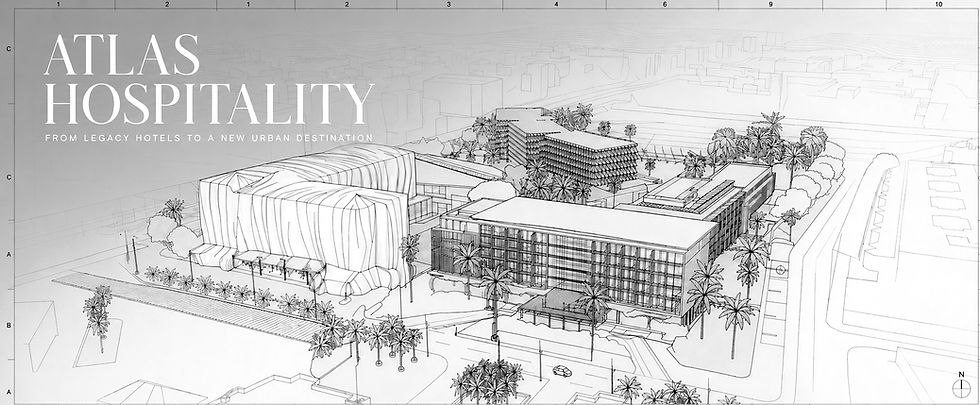
On Avenue Mohammed VI, within what can be considered part of Marrakech’s hospitality Golden Triangle, Atlas Hospitality is not simply renovating two hotels.
It is creating a new destination within a destination.
The transformation of the former Atlas Asni and Atlas Medina complex represents the first physical expression of a broader vision: moving from individual hotels towards an integrated hospitality model.
Led by Atlas Hospitality within the Al Mada ecosystem, the project represents an investment of approximately 600 million MAD across a total area of 61,313 m².
The ambition is not only architectural.
It is strategic.
Three hospitality concepts will coexist within the same destination:
MO — the premium and luxury expression of the ecosystem, following the logic already demonstrated by The View brand.
KAAN — an upscale lifestyle and business-leisure concept.
My Relax — an accessible volume-driven concept.
The strategic intelligence is not only in the individual brands.
It is in the combination.
Different price points allow the destination to address different customer profiles, seasons, distribution channels, and lengths of stay.
A premium guest may generate higher ancillary spending through restaurants and experiences.
An upscale guest contributes balance and flexibility.
A volume concept creates accessibility and daily energy.
Three brands, three market positions, one shared destination.
This is the first concrete expression of the new Atlas model: assets, brands, and experiences working together rather than operating as separate hotel units.
But every transformation has a price.
By temporarily removing two established Marrakech hotels from operation, Atlas accepted a significant short-term sacrifice in order to create long-term value.
Using conservative market assumptions, the temporary removal of Atlas Asni and Atlas Medina represents an estimated 20 million MAD in monthly room revenue opportunity.
This figure concerns accommodation only. It excludes restaurants, bars, meetings, wellness, and other ancillary activities.
The visible investment is the 600 million MAD redevelopment.
The invisible commitment is the revenue temporarily sacrificed while the future asset is being created.
That is the difficult equation of institutional hospitality investment.
A hotel can remain open and slowly lose relevance.
Or an owner can accept a period of silence, invest heavily, and return with a stronger market proposition.
The Meeting Point chapter
The later Meeting Point Hotels Morocco structure belongs to the next chapter of the same story.
Atlas and FTI entered a 50/50 joint venture to develop club-style hospitality assets in Morocco.
The logic was straightforward: Atlas brought local assets and know-how, while FTI brought distribution reach and international packaging power.
But the real foundation was already there.
The portfolio had been built earlier, including the properties that came out of the Fram acquisition.
That is why the later restructuring makes sense only if you view it as a continuation, not as an isolated deal.
When FTI entered insolvency in 2024, the fragility of that cross-border dependence became impossible to ignore.
Atlas’s move to regain full control of Meeting Point Hotels Morocco was therefore not a routine commercial adjustment.
It was a correction: bringing the asset logic back under domestic stewardship and restoring coherence to a portfolio that had always belonged, in an important sense, to the Moroccan side of the table.
Beyond the hotel room
What is most interesting about Atlas Hospitality today is that it no longer behaves like a traditional hotel operator alone.
Its activity in food and beverage — including Flavors Food Company with Marjane Group — shows a more mature understanding of hospitality as an ecosystem, not a single business line.
Hotels remain cyclical. Tourism moves with seasons, airlift, confidence, geopolitics, and pricing pressure.
A restaurant concept in the right retail or urban setting plays by a different rhythm.
It gives the group another source of daily consumption and another way to transform hospitality experience into recurring revenue.
In that sense, Atlas is not abandoning hotels.
It is broadening the definition of what hospitality can be.
The people behind it
Buildings are essential. Brands carry weight.
But no hospitality group can survive on architecture alone.
In the public restructuring narrative, names like Kamal Bensouda and Abbas Azzouzi are frequently cited — and rightly so. They played key roles in steering the group through a period of significant transition.
But the real story of Atlas Hospitality is also a story of teams, operational discipline, and years of patient work by professionals whose names rarely make the headline.
I worked alongside people from that era, and I still look back on those years as a defining decade for Moroccan hospitality.
It was a time when business was more direct, more personal, and in many ways more demanding.
Decisions were made face-to-face. Trust counted. Presence counted.
We argued. We negotiated. We challenged one another.
But we also built something lasting together.
And that, to me, is what hospitality truly is: not just structures and spreadsheets, but a long chain of people who hold the system together.
The hotels will be renovated.
The brands will evolve.
Ownership may shift again.
But the people who carried this industry through its hardest and most formative years deserve a permanent place in its story.
Because behind every hotel group, there is always a generation of professionals whose names rarely appear on the façade — but whose fingerprints remain on the walls, in the lobbies, and in the memory of the business itself.
From the outside, the transformation may look like absence: construction barriers, closed entrances, familiar names temporarily disappearing from the Marrakech landscape.
But behind those walls, the strategy is visible.
Atlas is not simply renovating two hotels.
It is testing a new model for Moroccan hospitality — one where ownership, brands, experiences and destinations are designed to work together.
The project’s value will depend not only on the number of rooms reopened, but on whether Atlas can create a more coherent destination model.
It will be measured by whether Atlas succeeds in creating something more valuable: a hospitality destination with its own identity, its own ecosystem, and the ability to serve different generations of travellers.
That is the real transition.
From hotel owner to hospitality platform.
Time for a T.


Comments