
Agafay Quad Excursion from Marrakech for €14: How Does It Work?


Peter manshoven | behind the lobby.
A technical and economic examination of a GetYourGuide Agafay Quad Excursion from Marrakech for €14.
When I was having a latte macchiato with a shot of noisette with a friend from abroad, who will be travelling solo through Morocco and neighbouring countries for the next few months, we started talking about his morning adventure in Agafay.
He had found a half-day excursion for €14.
Central pickup, a stone’s throw from his riad, approximately two hours of quad driving, and a tea stop with a local inhabitant.
He had enjoyed it.
Actually, he was perfectly happy with the result.
And that is what made me ask the question.
How the hell do they do it?
From the customer's point of view, there is another important part of the equation: flexibility.
The client is not necessarily asking for a private car, a private guide or a tailor-made departure.
A shared vehicle, a fixed activity period, an older but perfectly usable quad and some flexibility about exactly how the morning is organised can all be perfectly acceptable when the experience itself delivers what the customer expected.
And in this case, it did.
My friend was happy with his morning.
So this is not an article about whether a €14 excursion is “good” or “bad”.It is a different question.
How can a tourism business provide that experience, satisfy the customer, pay its people, operate its vehicles and machines, absorb platform commission, fuel, maintenance, insurance and all the other costs — and still sell it for €14?
That is the question that started this analysis.
1. The price that raises the question
In many European cities as in Marrakech, €14 barely covers two latte macchiatos with a shot of noisette, parking, and a modest tip.
Yet the same amount can buy, on GetYourGuide, a shared half-day excursion that includes central pickup in Marrakech, a short walk from the client's riad, a return transfer to the Agafay Desert, approximately two hours of self-driven quad biking, and mint tea with a local inhabitant.
The Agafay Desert lies only 30–40 kilometres southwest of central Marrakech. The drive takes 40–50 minutes on paved roads.
It is a rocky plateau of stone hills, dry riverbeds and open views toward the Atlas Mountains — not the classic sand dunes of the Sahara, but a dramatic and accessible landscape that has become one of the most popular half-day escapes from the city.
Standard commercial prices for a comparable two-hour guided quad package with transfer and tea normally range from €30 to €50 per person.
Private transfers alone often cost €50–80 round-trip for a vehicle. A €14 all-in price therefore sits at the extreme low end of the market.
The question is not whether the product exists — it does — but how the underlying business model can sustain it after platform commissions, fuel, labour, vehicles, insurance and the other ordinary costs of operation.
This article reconstructs that model using the concrete details of one real booking: a group of five people collected in a small MPV-type vehicle, sold through GetYourGuide, with approximately two hours of quad driving and a tea stop with a local inhabitant.
2. Market context and the role of the platform
GetYourGuide and similar online travel agencies typically retain 20–30 % of the retail price as commission.
On a €14 ticket the platform therefore keeps roughly €2.80–4.20, leaving the local operator with a net of approximately €9.80–11.20 per rider before any other costs.
In addition, informal referral commissions remain common in the Marrakech tourism ecosystem.
Taxi drivers, hotel or riad staff, and independent “guides” who direct clients toward an activity frequently receive a kick-back.
These payments further reduce the net amount that reaches the operator who actually runs the vehicles and the guide.
The operator who accepts a €14 GetYourGuide booking is therefore working with a thin residual revenue while still having to deliver transport, machines, a guide, fuel, basic safety equipment, a tea stop, and some form of insurance.
3. The real operating picture: five riders in a small MPV
The group size and the type of transfer vehicle are decisive.
A group of five is below the ideal volume that most efficiently spreads fixed elements, yet it is still large enough to be workable with a compact vehicle.
The transfer was performed not in a large minibus, an H1 or a 4×4, but in a small MPV-type vehicle, broadly in the Kangoo/Duster class — a small, inexpensive multi-purpose vehicle widely used in Morocco for light commercial work.
Such a vehicle has low purchase or lease cost, modest maintenance requirements, and relatively low fuel consumption.
A round-trip of 80–100 kilometres in such a vehicle typically consumes considerably less fuel than a larger tourist vehicle. Wear-and-tear and basic running costs remain correspondingly low.
The choice of vehicle is therefore not accidental; it is one of the structural ways the operator keeps the cost base compatible with a €14 retail price.
4. Cost structure of a single departure
The main variable cost items for a five-person departure Agafay Quad Excursion from Marrakech for €14 can be estimated as follows, using mid-range figures for 2026 local conditions:
Small MPV fuel and light wear: €12–20
Fuel for five automatic quads, approximately two hours of rocky terrain: €25–40
Maintenance and wear allocation on the quads — tyres, brakes, cables, oil: €8–15
Guide or instructor for briefing, ride and tea stop: €15–35
Tea and simple hospitality with a local inhabitant: €5–12
Safety-gear amortisation — helmets, goggles: €3–8
Allocation of obligatory insurance: €4–10
Total variable and insurance-related cost for the departure: roughly €72–140, with a realistic mid-point around €105.
After a 25 % GetYourGuide commission, the net revenue from five riders is approximately €52.50. The contribution margin on variable costs is therefore negative under mid-range assumptions.
Only under the most disciplined lean conditions — owner-operator labour, excellent fuel economy, minimal insurance allocation, tightly controlled maintenance — does the departure approach break-even on variable costs, and even then only when the group size rises toward 11–12 riders.
That is where the arithmetic becomes interesting.
5. The decisive role of fully depreciated machines
The single most important economic adjustment in the low-price segment is the treatment of capital cost.
Many operators in this price range work with older automatic quads, typically 250–450 cc, that have already completed several hard seasons.
Once a machine is fully written off in the accounts, or was acquired second-hand at a low residual value, its capital cost is effectively no longer a cash cost of each individual excursion.
The remaining cash outflows are fuel, occasional parts, maintenance and the owner's time for repairs.
This is the central mechanism that allows the arithmetic to come close to closing.
Newer machines with significant remaining capital cost are much harder to operate profitably at €14 after platform commission.
The fleet is effectively run at near-zero capital cost.
Fuel, parts and basic insurance remain real cash costs. Depreciation does not.
The same logic applies, to a lesser extent, to the transfer vehicle. A well-used small MPV that has already been depreciated or was purchased cheaply keeps the capital charge close to zero.
6. Labour and the owner-operator model
Guide and driver labour is another area where costs can be heavily compressed.
In many small operations the owner himself drives the transfer vehicle, conducts the safety briefing, leads the ride and organises the tea stop.
When labour is not paid at a full commercial daily rate, one of the larger potential cost lines disappears or shrinks dramatically.
Even when a separate guide is used, local daily rates for this type of work remain far below European equivalents.
The combination of owner-operated labour and relatively low local wage levels is therefore an important element of the model.
7. Insurance: the legal minimum and the administrative question
Moroccan regulations require third-party liability cover (responsabilité civile) for vehicles that carry paying clients and for organised tourist activities. Reputable operators, especially those selling on major platforms, are expected to maintain such cover.
The economic question, however, is not whether insurance exists in principle.
It is:
What insurance, for what activity, for which vehicles, and under which operating structure?
That distinction becomes particularly relevant in a destination such as Agafay.
The area has previously attracted administrative and judicial controls concerning
establishments and tourism or recreational activities operating outside the applicable regulatory framework.
In late 2023, Moroccan media reported controls in Agafay involving unauthorised establishments and broader concerns about compliance within the rapidly expanding tourism and recreational sector.
These reports do not establish anything about the operator examined in this article. They simply illustrate the regulatory environment in which these activities operate.
For an administrative control, the interesting questions would therefore be documentary:
Which company is operating the activity?
Which vehicles are being used?
Which quads are covered?
What insurance applies to the activity?
Who is responsible for the clients?
Which authorisations apply?
And does the documentation correspond to the activity actually being carried out?
This is where the economics become interesting.
A €14 selling price does not prove that an operator is uninsured or non-compliant.
It simply means that all the applicable costs — including insurance and compliance — have to fit somewhere inside an exceptionally compressed revenue model.
At the extreme low-price end of the market, economic pressure creates an incentive to minimise every cost that can legitimately be reduced.
Whether an individual operator actually does so, and whether the resulting operation complies with all applicable requirements, is a matter of fact and documentation rather than something that can be inferred from the selling price alone.
Even when proper minimum insurance is maintained, the annual premium is spread across hundreds of departures, so the per-outing allocation remains modest — potentially only a few euros for a small group.
The key point is therefore not to assume non-compliance.
It is to recognise that insurance and compliance are real costs in the economic equation.
8. Daily capacity and the limits of volume
A two-hour riding slot plus transfer and tea still leaves room in a working day for multiple departures.
A well-organised operator can realistically schedule three or four waves — for example early morning, late morning, early afternoon and late afternoon.
Higher daily capacity improves the spreading of fixed costs, but it does not by itself solve the problem.
Even at four full departures every day, a pure €14 product with mid-range costs and platform commission does not generate enough contribution to cover realistic monthly fixed costs such as fleet, base insurance, workshop, minimal overheads and owner draw.
Break-even on fixed costs alone would require an impractically high number of departures if this were the only product.
In practice, the €14 GetYourGuide seats can function as volume fillers and may also be seen as an investment in the brand — generating visibility, reviews and platform presence that can contribute to more valuable bookings later.
The real margin is more likely to be made on a mix of higher-priced packages, direct bookings that avoid the full platform commission, private groups, and occasional upsells.
9. The €14 product may not be the real product
There is another part of the equation that is easy to miss when looking only at the €14 selling price.
The €14 excursion does not necessarily have to make its money from the €14 excursion.
In tourism, the first transaction can also be a customer-acquisition tool.
A very low entry price gets the customer through the door — or, in this case, into the vehicle. Once the customer has arrived in Agafay and has experienced the operator's service, a number of additional commercial opportunities become possible.
One of the most obvious is the quad and camel combination.
For a visitor who has already made the journey to Agafay, adding a camel experience to the quad excursion can be a very attractive proposition. The two activities complement each other, require little additional transport, and allow the operator to increase the value of the same customer visit.
The same applies to a buggy upgrade.
The customer may initially book the €14 quad experience because it is the lowest visible entry price. Once on site, the possibility of upgrading from a quad to a buggy can transform the economics of that customer. The infrastructure, location and much of the organisation are already in place; the additional revenue therefore does not necessarily require a proportional increase in the original acquisition cost.
Other possibilities can include:
extending the riding time;
upgrading from quad to buggy;
combining quad and camel riding;
adding a private transfer;
adding a meal or sunset experience;
photography or video;
booking another excursion during the stay;
or eventually converting the customer into a direct client.
The economics of these additional sales can be completely different from those of the original €14 activity.
A customer acquired through GetYourGuide may have cost the operator a significant percentage of the first transaction in platform commission.
But once that customer is already in Agafay, an additional service sold directly may carry a very different margin.
This is where customer acquisition cost becomes relevant.
The €14 excursion can therefore be viewed not only as a tourism product, but potentially as an entry point into a much larger customer relationship.
The same applies to reviews and visibility.
A customer who books, enjoys the experience and leaves a positive review contributes something that does not appear in the €14 revenue line. The review can help the operator remain visible on the platform, attract additional customers and strengthen the commercial credibility of the product.
In that sense, the €14 seat may have several economic functions at the same time:
revenue, capacity utilisation, customer acquisition, brand exposure and potential future sales.
It can even be seen as an investment in the brand.
The relevant calculation may therefore not be:
“How much profit is made on this €14 ticket?”
but rather:
“How much does it cost to acquire this customer, and what is that customer potentially worth afterwards?”
That is a very different business model from simply trying to make a healthy margin on every €14 ticket.
And it may explain why an apparently extraordinary €14 price can remain commercially interesting even when the arithmetic of the individual departure looks remarkably tight.
10. Safety implications of the cost structure
The same pressures that keep the price at €14 also affect safety margins.
What is normally still present: basic helmets and goggles, a short briefing, a guide who leads the group, and at least nominal third-party liability cover.
What is under pressure: the age and mechanical condition of the quads, the quality and consistency of maintenance, the guide-to-client ratio, and the robustness of emergency procedures.
Older, fully depreciated machines can be operated safely if the owner is rigorous; they can also be operated with deferred maintenance when cash is tight.
The low price itself is therefore not proof of poor safety.
It is a signal that the maintenance and operating budget is constrained and that the operator must allocate limited resources very carefully.
Safety is therefore not automatic.
It depends on the individual operator's standards and discipline.
Platform ratings and recent independent reviews remain the practical tools available to a client.
11. Synthesis: how the model actually works
The €14 GetYourGuide Agafay quad-and-tea excursion is commercially sustainable only under a tightly defined set of conditions:
Transfer performed in a basic, low-cost vehicle such as a small MPV.
Quads that are already fully depreciated or acquired at residual value, so that capital cost is close to zero.
Labour that is owner-operated or paid at a relatively low local rate.
Insurance maintained within the applicable legal framework at a cost compatible with the operation.
High daily utilisation, with three to four departures when demand allows.
Acceptance that the product may function as a volume filler rather than a major profit centre, with stronger margins potentially coming from other, higher-priced or lower-commission sales.
When these conditions are met, the residual revenue after platform commission can cover some or all of the remaining cash costs of fuel, basic parts, insurance and simple hospitality.
When any of the conditions is relaxed — newer machines, full commercial labour rates, higher insurance costs, or consistently small groups — the model moves quickly into loss.
The comparison with two latte macchiatos, parking and a tip is therefore not merely rhetorical.
It reflects the extreme compression of costs that is required.
The operator is not performing magic.
He is running a high-volume, near-zero-capital, low-labour operation in a low-cost local environment, using the platform for distribution while accepting that the €14 seats themselves may contribute little or nothing to profit.
That is how the arithmetic can close.
It is a coherent business model under the specific constraints of the Marrakech–Agafay corridor.
It is also a model that leaves limited room for safety buffers, fleet renewal or robust insurance.
And that, ultimately, is why the €14 price is interesting.
Not because the client necessarily receives a poor experience.
Quite the opposite.
My friend came back happy.
The interesting question is how much economic engineering is required behind the scenes to make a customer happy for the price of two coffees, parking and a tip.
That is what I wanted to understand.
Time for a T.
By Peter Manshoven for peter.ma
Disclaimer
This analysis is an attempt to understand the economic logic of a very low-priced tourism product. It is not an accusation against any specific operator, platform, or individual.
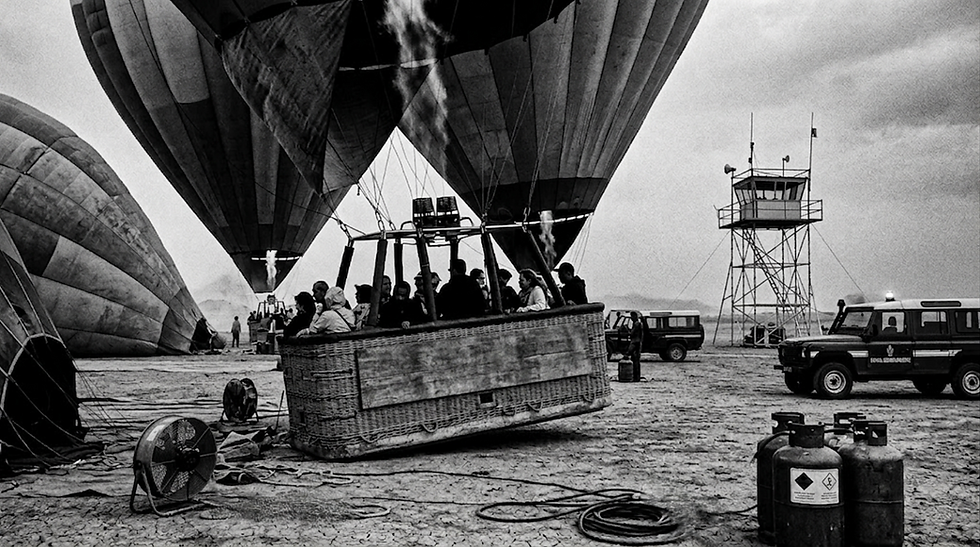
We examine cost structures, commission levels, vehicle choice, depreciation, labour, and insurance practices in the same spirit as previous industry studies of the hot-air balloon sector: by looking at how thin margins, high volume, and local cost conditions interact.
The goal is to explain how a €14 half-day excursion with return transport, two hours of quad driving and tea with a local inhabitant can exist after platform commissions, not to claim that any particular company is breaking the law or cutting corners.
Practices such as the use of older, fully depreciated machines, owner-operated labour, basic transfer vehicles, or minimum insurance arrangements are discussed as possible economic responses to extreme price pressure. Whether any given operator actually uses them is a matter of individual business decisions and local regulation.
The regulatory context is relevant because Agafay has previously been subject to administrative and judicial controls involving unauthorised establishments and tourism or recreational activities operating outside the applicable framework. Such controls do not establish anything about the operator examined here; they simply illustrate that compliance costs and documentation form part of the real operating environment.
Our purpose remains purely analytical: to map the real constraints and trade-offs of the business model.
Comments