
When Mass Becomes a Hazard: The Hot Air Balloon Industry in Marrakech

Updated: Jul 22
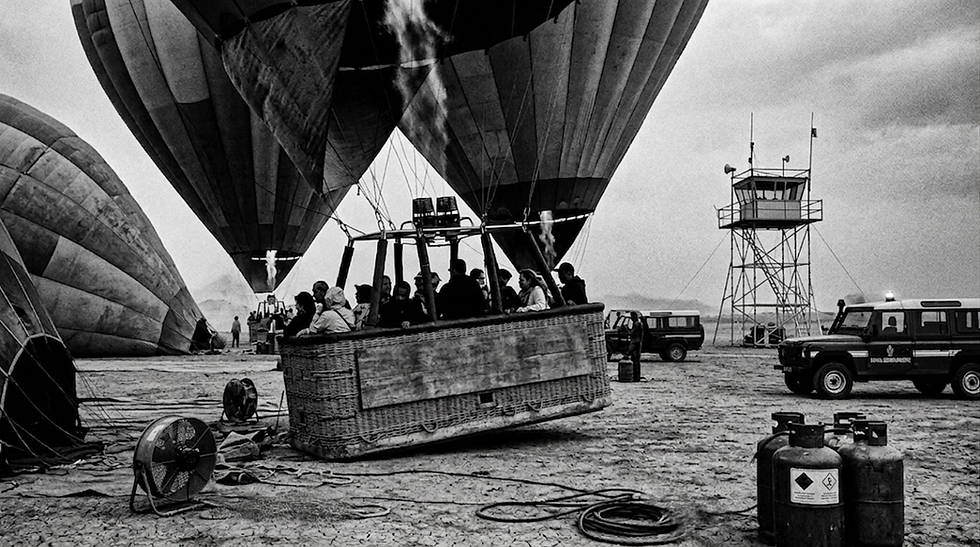
A Study in Operational Integrity vs. Massification
In 2008, at the highest point of Marrakech—the road behind the Victor Hugo school—there was a balloon. Maybe two. The name painted on the envelope was Ciel d'Afrique. In those early days, their offices were nestled in front of the McDonalds. From that upper floor, they decided when to fly, who could fly, and set prices based on market reality, cost analysis, and a healthy margin befitting what was effectively a territorial monopoly.
But when pigeons see free corn, they come in mass. That is exactly what happened in Marrakech. There was good-quality corn—and then other suppliers arrived.
Today, the Marrakech sky is no longer an exclusive frontier. It has become a crowded operating environment where state-funded expansion meets aggressive pricing. In 2008, one operator. In May 2025 alone, Moroccan authorities sanctioned twelve.
For anyone who has watched this market evolve over nearly two decades, the prevalence of low-price offerings raises legitimate questions about whether operational buffers have been maintained.
1. The Subvention Machine: Financing Low-Cost Operations in Marrakech
The surge of new balloon operators is a direct byproduct of Go Siyaha (Go Tourism) and Maroc PME programs—pillars of Morocco's 2023–2026 Tourism Roadmap.
Investment Support: Under the Investment Charter (Law 03-22), "Tourism Animation" projects are eligible for direct grants. For investments capped at 10 million MAD, operators receive 30–35% of startup costs (bases, vehicles, balloons) under the Go Siyaha program.
Program Expansion (July 22, 2025): The previous 1M MAD minimum investment threshold was abolished, opening subsidies to smaller tourism entrepreneurs.
Program Scale: Go Siyaha has already supported 1,000 projects and aims to reach 1,700 tourism enterprises by 2026 with a total budget of 720 million MAD.
Factual conclusion: State subsidies lower the barrier to entry. More operators can launch with less private capital.
Price excursion Hot air balloon Marrakech Flying at a low seat cost Getyourguide excursion, Hot air balloon
2. The Stability Trap: Climate as a Double-Edged Sword
Marrakech's meteorological stability (300+ flight days per year) is a known industry asset. However, high operational predictability can encourage aggressive scheduling.
Fixed Cost Pressure: Industry-standard cost data indicates that a single balloon operation incurs annual expenses of approximately $86,000–$250,000 USD, including envelope replacement ($70,000–$90,000 every 3–5 years), propane ($50–$150 per flight hour), maintenance ($5,000–$20,000 annually), insurance ($5,000–$20,000 annually), pilot salaries ($40,000–$80,000 annually), and ground crew ($20,000–$50,000 annually).
Volume Dependency: At lower price points (e.g., sub-1,200 MAD), operators require consistently high load factors to cover these fixed costs.
Weather stability enables year-round operations, which puts pressure on operators to fly daily to service debt and fixed expenses. But with a winter like this one—where weather has become extremely bad, directly reducing available flight slots—the model breaks. With overhead costs unchanged and rates maintained at aggressive levels, where will the full-year forecast be corrected?
3. 2025: Documented Incidents and Regulatory Action
The rapid expansion of balloon tourism in Marrakech led to documented safety breaches in 2025, followed by unprecedented state intervention.
Date | Incident / Action |
May 4, 2025 | A commercial airline pilot filed a safety complaint reporting balloons flying dangerously close to his aircraft near Marrakech-Menara Airport |
May 26, 2025 | Morocco's Ministry of Transport and Logistics sanctioned 12 hot air balloon tour companies operating in the Marrakech region |
May 26, 2025 | 1 company had its operating license revoked and was referred to prosecutors |
May 26, 2025 | 1 company received a permanent suspension |
May 26, 2025 | Multiple companies received temporary suspensions ranging from two to six months |
May 26, 2025 | Violations included: flying above authorized altitudes and operating balloons without proper licenses (Air Operator Certificates) |
Ongoing | The Ministry is coordinating with Marrakech-Safi regional authorities and the Royal Gendarmerie to strengthen oversight |
Factual conclusion: In May 2025, Moroccan authorities formally determined that multiple balloon operators had violated aviation safety regulations, resulting in license revocations and suspensions.
4. The Operator Landscape: Market Segmentation
The Marrakech balloon market has bifurcated between two distinct operational models.
Model | Characteristics |
Premium Operators | Maintain international certification standards (EASA/FAA-compliant); operate smaller baskets (8–12 passengers); use newer envelopes |
Volume Operators | Operate with local certifications; use larger baskets (16–24 passengers); may use older envelopes (some exceeding 1,200 flight hours in Q1 2025 per DGAC findings) |
Factual conclusion: The market has split between higher-priced operators with established protocols and lower-priced operators driving volume. Regulatory action in 2025 confirmed that some operators in the latter category were operating outside legal requirements.
5. Morocco's Tourism Growth Targets (Context)
The balloon industry operates within Morocco's broader tourism expansion strategy.
Target | Figure |
Tourist arrivals by 2030 | 26 million |
Current arrivals (2025 estimate) | ~20 million |
Airport passenger capacity by 2030 | 80 million passengers/year (infrastructural capacity , not tourist arrivals) |
New tourism jobs by 2026 | 200,000 |
Go Siyaha program target | 1,700 enterprises supported by 2026 |
Factual conclusion: Balloon tourism is one of many sectors being actively expanded under national tourism policy.
6. Regulatory Response: What Is Known About 2026
Following the May 2025 sanctions, Moroccan authorities have announced strengthened oversight.
Enhanced Enforcement: The Ministry of Transport and Logistics is coordinating with regional authorities and the Royal Gendarmerie to implement stricter compliance measures.
Inspector Capacity: Additional aviation inspectors have been deployed.
Pending Regulations: Updated technical standards (ceilings, radio requirements, pre-flight filing) are under development or consultation.
Factual conclusion: Regulatory oversight of Marrakech balloon operations increased significantly after May 2025, with further measures anticipated in 2026.
The Verdict
The prevalence of very low pricing (e.g., 800 MAD) in the Marrakech balloon market is enabled by:
State subsidies through Go Siyaha and the Investment Charter (30–35% of startup costs)
High-volume operational models that require near-daily flights to cover fixed costs
A regulatory gap that allowed some operators to fly without proper licenses—partially closed by the May 2025 sanctions
In 2025, Moroccan authorities formally determined that multiple balloon operators had violated aviation safety regulations, leading to license revocations, suspensions, and enhanced oversight.
The full implementation of stricter 2026 standards remains to be publicly documented.
I see what they see. You will know what they don't.
Time for a coffee.


Comments