
Must-Try Experiences in Morocco: Moroccan Cultural Highlights and this little more.

Updated: Apr 27
Perfect inspiring ideas for a first time or second time traveller.
Morocco is a land of contrast — colour and silence, chaos and precision, tradition and acceleration.
It is not a destination you “see”. It is a country you learn to read.
I am not Moroccan by birth, but by long adoption through life and work. Over the years, Morocco has shaped the way I think, move, and observe. In Marrakech in particular, I have become Marrakchi in my own right — not by claim, but by belonging.
Morocco is not one experience. It is a mille-feuille of realities — layered, simultaneous, and often contradictory — each unfolding in a different place, at the same time.
Take the time to let unfold each layer of this rich country in your senses. This is what matters.
Which Dates to Avoid
Like all major destinations, Morocco has peak moments that have nothing to do with weather.
Avoid October.
On paper, it is perfect: mild temperatures, clear skies, ideal for touring. In reality, it has become the month of MICE travel — large international groups taking over Marrakech and Fes. Availability tightens. Flexibility disappears. Dynamic pricing takes control.
Be aware: even long-standing partners can feel underappreciated in October. That perception is not wrong. It is simply the market at work.
In Fes, timing is even more sensitive. Major events like the SIAM agricultural show (Salon International de l'Agriculture au Maroc) — a national institution — absorb hotel rooms across Fes and Meknes without ever appearing on the tourist radar. If you do not know, you only find out when it is too late.
If you travel Morocco in October and feel like a number rather than a guest, you are not imagining it.
Dive into Moroccan Cultural Highlights
Start in Marrakech. Wander the narrow alleys of the souks, where artisans craft leather and metalwork. The scent of spices fills the air.
Do not miss Jemaa el-Fnaa at sunset — storytellers, musicians, food stalls. This is the essence.
But do not forget to visit the popular neighbourhoods like Massira, where the main road becomes the biggest open-air hypermarket in the evenings. The next step is always worth it.
For something more introspective, visit Fes. Its UNESCO-listed medina reveals centuries-old madrasas and traditional tanneries.
A specific moment you will not read elsewhere: at the Chouara tanneries, a worker will hand you fresh mint leaves. Most tourists crush them immediately. Avoid that. Wait. Hold them loose. The smell hits in waves — first the tannins, then the mint when you need it.
Crush too early and you have wasted the only defence you have.
(I always have my Vapo Vick with me. And be sure: the smell without nasal support is a real appetite killer.)

When to Travel Differently
If you have already experienced Morocco once and want something deeper, consider Ramadan.
During the day, the country slows down. The rhythm softens, especially in Marrakech. You move through the streets with a sense of calm that is rare at other times of the year.
Then night falls.
Families gather. Cafés reopen. The scent of harira and fresh bread fills the air.
Be aware: if the idea of eating your main meal at 2am sounds exhausting, Ramadan is not your moment. If it sounds like a secret, it is.
You do not just visit Morocco. You follow its rhythm.
Explore the Sahara Desert
From Merzouga, the dunes stretch endlessly. A camel trek at sunset reveals the desert at its most poetic.
Spend the night in a desert camp. Under a sky untouched by light pollution, the silence becomes part of the journey.
Avoid the standard itinerary. Most travellers stay one night. That is a mistake.
The first night is adrenaline and stars. The second night is when the silence stops feeling strange and starts feeling like home. You wake before dawn not because an alarm tells you to, but because your body has finally matched the desert's rhythm.
Be aware: camp operators rarely offer the second night unless you ask. Ask.

Wander Through Majestic Moroccan Architecture
Moroccan architecture is often reduced to minarets and medina alleyways. That is only half the story.
Alongside the centuries-old madrasas, Morocco holds a remarkable Art Deco heritage. In Casablanca, find restored cinemas and apartment buildings from the 1920s and 1930s — the Cinema Rialto, the former Lyre Hotel, facades on Boulevard Mohammed V.
The Habous district? You go when you know what you are looking for — a specific artisan, a particular tile shop, a client meeting. If you do not have a reason to be there, you can skip it.
Be aware: Morocco is a country of traders. You will experience their DNA — the negotiating skill — during every visit to a real medina. You do not need a sanitised version to understand this. The souks of Fes and Marrakech will teach you soon enough.
Avoid the Habous if you are looking for "authentic Morocco without the hassle." That place does not exist. The hassle is part of the authenticity.
Instead, walk the blocks between Rue de la Gare and Avenue des FAR in Casablanca. The facades here are unrestored — fading paint, original ironwork, no boutiques. This is not a postcard. It is a neighbourhood that has not yet been cleaned for visitors. That is why you should see it now.
Then there is Rabat — undergoing its most ambitious architectural chapter in a century. The newly inaugurated Mohammed VI Tower — 250 meters, 55 stories, inspired by a rocket on its launchpad — now redefines the capital's skyline. Nearby, the Grand Théâtre de Rabat by Zaha Hadid Architects — the "magic bridge" — sits in deliberate dialogue with the historic riverbank.
The Art Deco past, the medieval Hassan Tower (12th century, unfinished, silent), and the futuristic Mohammed VI Tower (2026, gleaming, occupied) exist on the same map. One thousand years, separated by a river. That is rare. That is Moroccan architecture in full
Savor the Flavours of Moroccan Cuisine
A traditional tagine is essential — lamb with prunes or chicken with preserved lemons.
Couscous with vegetables and tender meat is a cornerstone. For something sweet, msemen or baklava.
But the dish that matters is rarely on restaurant menus: rfissa. Shredded msemen buried under spiced lentils, chicken, and fenugreek.
Be aware: rfissa takes time to prepare and time to digest. In modern Morocco, it has become a weekend dish — the kind you eat when you know your afternoon has only a siesta on the agenda. Nothing else.
Order it in a restaurant and you will be disappointed. Eat it in someone's home on a Friday afternoon and you will understand why Moroccans smile when tourists ask for "lighter" cuisine. It is not light. It is not fast. It is a commitment.
That is exactly the point.

Experience the Festivals
The Fes Festival of World Sacred Music brings together artists from across the globe in a setting that blends spirituality and history.
If you love this style — the trance, the devotion, the music as prayer — then you already know: Gnaoua in Essaouira is the other essential. Less polished than Fes. More rhythm. The city's coastal air and the guembri's low strings create something that stays in your chest for weeks.
And then there is Jajouka. The Master Musicians of Jajouka, in the Rif mountains. Harder to reach. Stranger to describe. Brion Gysin, William Burroughs, and Ornette Coleman all made the pilgrimage. If you know, you know. If you do not know, and this paragraph intrigues you — that is the door.
In Marrakech, the Marrakech International Film Festival showcases a more contemporary cultural face.
And the one almost no traveller finds: two weeks before the Sacred Music Festival, Fes lives its most authentic moment with Andalusian music gatherings in the gardens of private palaces. With no trace on the internet and no ticket booths, these nights are an open secret where entry depends on your connection with the local music conservatory or a riad owner who knows the gatekeeper.
For equestrian tradition at its most authentic: seek the real Fantasia at the Moussem of El Jadida or the regional festivals around Meknes. Here, horsemen ride for pride, not payment. The powder is real. The ground shakes.
The rhythm is not set to a bus schedule. That is the spectacle worth travelling for.
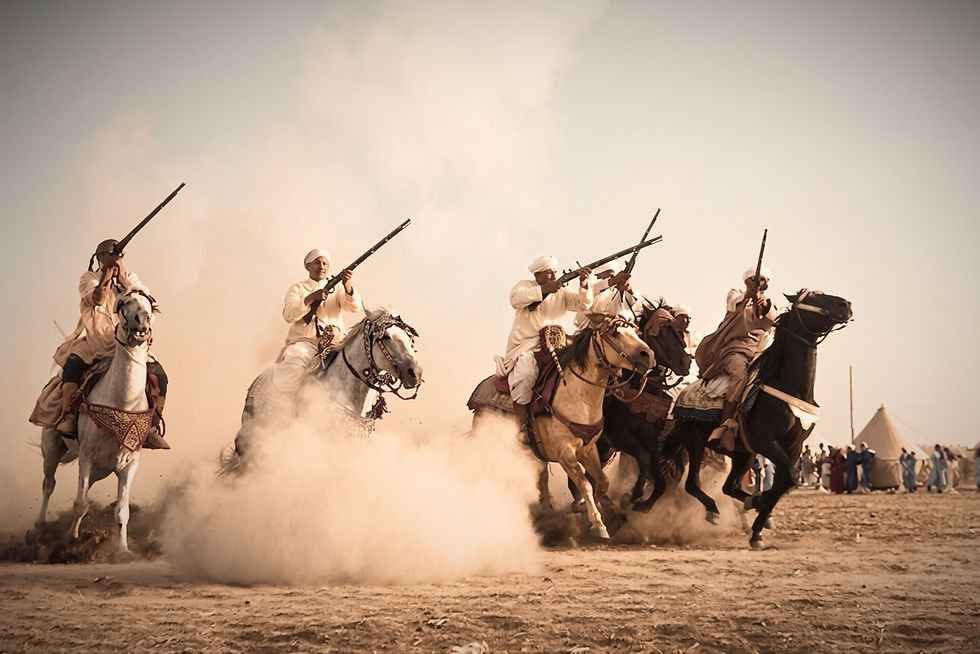
Equestrian tradition in Morocco
Tailor Your Journey with Exclusive Experiences
For those seeking luxury and exclusivity, Morocco offers bespoke experiences that go beyond the usual tourist trail. Private guided tours through ancient medinas, helicopter rides over the Atlas Mountains, and stays in lavish desert camps are just a few options.
I recommend working with a specialist who understands the nuances of Moroccan culture and can craft an itinerary that suits your tastes. Whether it’s a private dinner in a palace or a spa day in a traditional hammam, these personalised touches elevate your trip to something truly extraordinary.
If you’re curious about more unique options, exploring our experiences or just giving me a call can open doors to curated adventures designed for discerning travellers.
A Note on Timing your experience in Morocco
Here is what you need:
Marrakech: two full days. Not one.
Fes: two full days. The medina is larger than you think. You will get lost. That is the point.
The Sahara: three days if you want the second night in the dunes. Two if you only want the postcard. You know which one I recommend.
Casablanca and Rabat together: one long day with a private driver. Start in Casablanca's Art Deco streets. End in Rabat at the Grand Théâtre as the light changes.
Be aware: these are not rules. They are the minimum to feel each place, not just see it.
The Best Morocco
The best Morocco is the one you meet on its own terms, not yours. Arrive with a plan. Hold it loosely. And when something goes wrong — a delayed train, a wrong turn, a misunderstanding — do not rush to fix it. That pause is often the door you did not know you were looking for.
Time for a T.
Peter


Comments