
Discovering the Diverse Deserts of Morocco: A Luxury Traveler's Guide

Updated: Aug 4

Most visitors arrive in Morocco dreaming of golden dunes stretching beyond the horizon. They picture themselves riding a camel into the sunset, watching the sand glow in shades of gold and amber before spending a night beneath a sky filled with more stars than they have ever seen.
Those dreams can absolutely become reality.
But they reveal only one chapter of a much larger story.
Morocco's deserts are among the most diverse landscapes in North Africa. Towering seas of sand, rocky plateaus, endless gravel plains, fertile oases, and ancient caravan routes all belong to the same extraordinary world. Understanding these differences doesn't simply help you choose where to go—it transforms the way you experience Morocco.
You stop seeing "the desert" as a single destination and begin discovering an entire landscape shaped by millions of years of geology, history, and human resilience.
The Short Answer: Three Iconic Desert Experiences
Morocco offers three iconic desert experiences:
Erg Chebbi, near Merzouga, is Morocco's most famous sea of golden dunes and the classic introduction to the Sahara.
Erg Chigaga, reached via M'Hamid El Ghizlane, offers a far more remote and untouched wilderness where silence becomes part of the journey.
Agafay, just outside Marrakech, is not part of the Sahara at all. It is a spectacular rocky desert, known as a hamada, offering dramatic scenery and luxury escapes within easy reach of the city.
Each landscape tells a different story.
Morocco Is More Than the Sahara
One of the biggest misconceptions about the Sahara is that it consists entirely of sand dunes. It doesn't. Only a relatively small percentage of the Sahara is covered by towering dunes. Most of the world's largest hot desert consists of rocky plateaus, gravel plains, dry riverbeds, mountains, and ancient salt flats. Morocco showcases nearly every one of these landscapes, making it one of the best countries in the world to understand how deserts were formed.
Understanding Morocco's Desert Vocabulary
Before exploring Morocco's famous deserts, it helps to understand a few words you'll often encounter during your journey:
Erg – A Sea of Sand
An erg is a vast field of wind-shaped sand dunes. These are the landscapes that have become the universal symbol of the Sahara. Morocco has two famous ergs:
Erg Chebbi
Erg Chigaga
Although they belong to the same Sahara desert, they offer remarkably different experiences.
Hamada – The Rocky Desert
A hamada is a rocky desert. Instead of endless sand, the landscape consists of exposed rock, compact earth, and rolling stone-covered hills sculpted by centuries of erosion. Agafay is Morocco's best-known hamada.
Reg – The Gravel Desert
A reg is a gravel desert covered by countless small stones. Large parts of southern Morocco consist of reg landscapes, although most visitors cross them without realizing they are travelling through a completely different type of desert.
Oasis – Life in the Desert
Without water, there would be no life in the Sahara. Palm groves, kasbahs, and entire civilizations developed around underground water sources. Places such as Skoura, the Draa Valley, and M'Hamid El Ghizlane became essential stops for caravans travelling between North and West Africa.
How Morocco's Deserts Were Created
The story begins millions of years ago.
Ancient rivers flowing from the Atlas Mountains carried enormous quantities of sand, gravel, and rock into southern Morocco. As the climate gradually became drier, lakes disappeared, and the wind began shaping the landscape:
Fine grains accumulated into towering dunes.
Heavier rocks remained behind.
The result is the extraordinary variety of landscapes visitors discover today. The Moroccan desert isn't one landscape. It is an entire geological story.
Erg Chebbi – Morocco's Golden Sea of Sand

GPS Coordinates: 31.0996° N, 4.0172° W
Closest Village: Merzouga
Recommended Stay: 2 Nights
Best Season: → Best Time to Visit Morocco
Near the village of Merzouga rises Morocco's most iconic desert landscape. Some dunes exceed 150 metres in height and are constantly reshaped by the wind. At sunrise, they glow pale gold. During sunset, they become deep amber before turning brilliant orange. By night, the absence of light pollution reveals one of Morocco's most spectacular skies.
For many travellers, Erg Chebbi is the perfect first encounter with the Sahara.
M'Hamid El Ghizlane – The Last Oasis Before the Sahara
GPS Coordinates: 29.9354° N, 5.7783° W
Landscape: Oasis
Gateway to: Erg Chigaga
Recommended Stay: 1 Night
Many travel websites simply call it M'Hamid, while others mistakenly describe it as a desert. Neither is entirely correct.
M'Hamid El Ghizlane is the last permanent oasis village before the open Sahara. For centuries, caravans departed from here carrying salt, spices, gold, and manuscripts towards Timbuktu and West Africa.
Today, every journey to Erg Chigaga passes through M'Hamid El Ghizlane.
Here, the asphalt ends.
The tracks begin.
The Sahara gradually takes over.
Erg Chegaga – Where the Sahara Becomes Wild

GPS Coordinates: 29.9774° N, 6.1870° W
Landscape: Erg (Sea of Sand)
Access: 4x4 Required
Recommended Stay: 2–3 Nights
Best Season: → Best Time to Visit Morocco
If Erg Chebbi is Morocco's best-known desert, Erg Chigaga is its wildest. Reaching these immense dunes requires leaving paved roads behind and travelling by 4x4 across the open desert. There are fewer camps. Fewer visitors. Far more silence. Here, the desert feels almost untouched. The dunes constantly change shape under the influence of the wind, ensuring that no two visits are ever exactly the same. Many experienced travellers consider Erg Chigaga Morocco's most authentic Sahara experience.
Agafay – The Rocky Desert That Isn't the Sahara
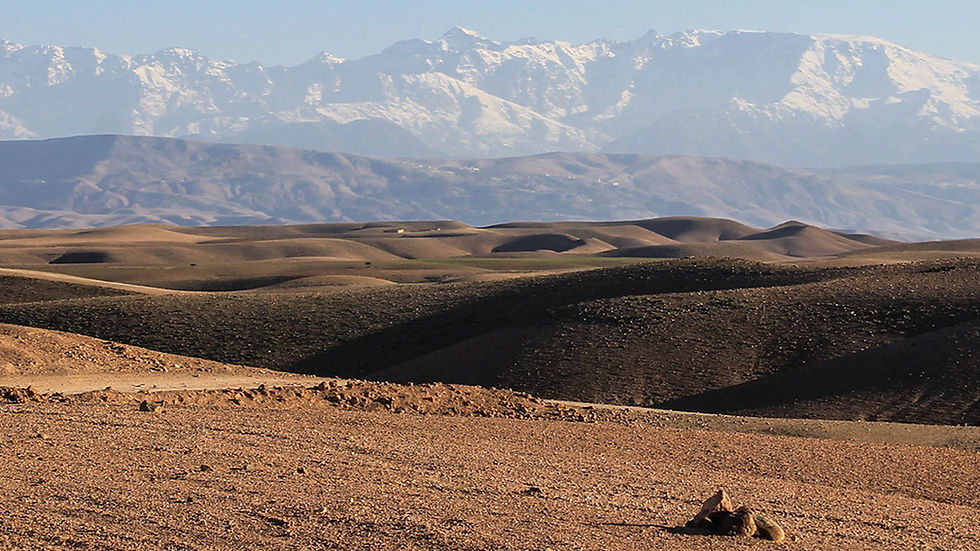
GPS Coordinates: 31.4460° N, 8.0453° W
Landscape: Hamada (Rocky Desert)
Distance from Marrakech: Approximately 35 km
Recommended Stay: 1 Night
Best Season: Year-round
Less than an hour from Marrakech lies one of Morocco's biggest surprises. Agafay is often described as "the Marrakech Desert." Technically, that isn't correct. Agafay is a hamada, not a sea of sand. Rolling rocky hills, dry riverbeds, and spectacular views of the High Atlas Mountains create a landscape unlike anywhere else in Morocco. Its proximity to Marrakech has transformed Agafay into one of Morocco's leading luxury destinations.
When Is the Best Time to Visit Morocco's Deserts?
The desert changes dramatically with the seasons:
Spring and Autumn generally offer the most comfortable temperatures for exploring the Sahara.
Summer brings intense daytime heat.
Winter often surprises visitors with freezing nights beneath exceptionally clear skies.
Choosing the right season can completely transform your experience. You should really start to plan a long time in advance as the top seasons for the desert, like October and April, are not a hidden secret anymore. → Best Time to Visit Morocco
More Than Beautiful Landscapes
The Moroccan desert is far from empty. It is home to nomadic traditions, remarkable wildlife, ancient trade routes, and some of the country's oldest settlements. For thousands of years, caravans connected North Africa with the kingdoms of West Africa, transporting salt, gold, spices, textiles, and knowledge across landscapes many believed impossible to cross.
Every oasis tells the story of water.
Every kasbah tells the story of trade.
Every dune tells the story of the wind.
The Desert I First Met Nearly Two Decades Ago
My relationship with Morocco's deserts didn't begin on top of a dune. It began on the road. Long before I reached Zagora or the Sahara itself, I found myself looking through the window, wondering how life could exist in such an unforgiving landscape. Then, almost without warning, the scenery changed. Thin ribbons of green appeared beside the road, following the river and fed by ingenious irrigation systems that had sustained life here for centuries. Palm groves emerged where I expected only dust and stone, reminding me that in the desert, water has always been more precious than gold.
When I finally arrived in Zagora, I experienced something I still struggle to explain. It felt less like discovering a new destination and more like coming home. I stayed in one of the small family-run riads, surrounded by miniature palm groves and the quiet rhythm of oasis life. Nothing felt staged. There were no performances for visitors, no carefully crafted experiences. Life simply unfolded at its own pace, and I had the privilege of becoming part of it.
What stayed with me most, however, were the people. Over more than three decades in Morocco, the people of the Sahara have become a constant thread running through my life. Some welcomed me as a visitor. Many became friends. A few became family in every way except by blood. Together we celebrated good years. Together we endured difficult ones.
Personal storms, the collapse of tourism during the COVID years, and the earthquake that shook Morocco tested lives, families, and businesses alike. Yet those friendships never disappeared. They reminded me that the true wealth of the Sahara has never been its dunes, but the resilience, generosity, and quiet dignity of the people who call it home.
The desert I first discovered has inevitably changed. Tourism has brought opportunity, improved roads, and better living standards. It has also asked for sacrifices. Some of the untouched simplicity that first captivated me has gradually given way to the realities of welcoming millions of visitors each year. That is neither entirely good nor entirely bad. It is simply the story of a living place that continues to evolve.
Every time I return to the south of Morocco, I still admire the dunes. But it is the people I look forward to seeing. That, more than anything else, is why the Sahara keeps calling me back. From that very first journey, I also learned something else: no two deserts are the same. Understanding the differences between Merzouga, Erg Chigaga, and Agafay enriches every journey into southern Morocco.
Where to Fly Into for the Sahara
One of the first decisions you'll make when planning a trip to the Moroccan Sahara isn't which camp to book or which dunes to visit—it's which airport to fly into. Contrary to what many travelers believe, there isn't a single "Sahara airport." Morocco offers several gateways, each suited to a different type of journey. Some are ideal for the classic road trip across the High Atlas Mountains, while others place you within a couple of hours of the dunes. Here's what each airport offers.
Marrakech Menara Airport (RAK)
Morocco's Main Gateway to the Sahara and the Perfect Flight for Agafay
Marrakech is Morocco's busiest international airport and the country's principal gateway for travelers heading to the desert. It offers the widest choice of direct flights, with an extensive year-round network from France, Spain, the United Kingdom, Belgium, Germany, Italy, the Netherlands, and many other European destinations.
Travel Intelligence
If this is your first visit to Morocco, Marrakech remains the best arrival airport. It combines the country's strongest international connectivity with the classic route through the High Atlas, Aït Ben Haddou, and the Sahara.
Errachidia Moulay Ali Cherif Airport (ERH)
The Closest Airport to the Dunes
Located in the Tafilalt region, Errachidia is the closest commercial airport to Erg Chebbi and Merzouga. The airport is served by regular domestic flights from Casablanca and a seasonal direct service to Paris-Orly, typically operating during the winter season.
Travel Intelligence
If your priority is spending more time in the desert and less time on the road, Errachidia is the most convenient arrival airport for Merzouga.
Fès-Saïss Airport (FEZ)
The Northern Gateway to Merzouga
Fès offers an excellent network of direct flights from France, together with regular and seasonal connections from Spain and other European cities. It is the preferred arrival airport for travelers beginning their journey in northern Morocco.
Travel Intelligence
Flying into Fès allows you to discover Morocco's imperial cities before following the spectacular route through the Middle Atlas and the Ziz Valley to the Sahara.
Ouarzazate Airport (OZZ)
The Smart Connection via Casablanca
Ouarzazate offers a limited number of seasonal international flights, but its greatest strength is its regular connection with Casablanca, Morocco's main international hub. This makes it an excellent option for travelers arriving on long-haul flights from North America, the Middle East, or Africa.
Travel Intelligence
If you're connecting through Casablanca, Ouarzazate provides one of the easiest ways to reach southern Morocco without crossing the High Atlas from Marrakech.
Agadir Al Massira Airport (AGA)
The Gateway to Erg Chigaga
Agadir enjoys a strong network of direct flights from France, together with year-round and seasonal services from Spain and several other European markets. It is the preferred gateway for travelers heading towards M'Hamid and the remote dunes of Erg Chigaga.
Travel Intelligence
Agadir is an excellent choice if you want to combine Morocco's Atlantic coast with the country's most remote desert landscapes.
At a Glance
Airport | IATA | Europe | Worldwide | Best For |
Marrakech Menara | RAK | Exceptional – one of Morocco's largest European networks with year-round and seasonal flights across Western, Southern and Northern Europe. | Excellent – direct links beyond Europe, including the Middle East, with easy access from North America and Africa via Casablanca. | First-time visitors & classic Sahara road trips |
Errachidia Moulay Ali Cherif | ERH | Limited – seasonal Paris-Orly service plus domestic flights. | Good via Casablanca – easy onward connections through Morocco's main international hub. | Fastest access to Merzouga |
Fès-Saïss | FEZ | Excellent – extensive European network, particularly France, Spain, Belgium, and Italy. | Good via Casablanca – worldwide connections available through Morocco's hub. | Northern Morocco & Merzouga |
Ouarzazate | OZZ | Limited – selected seasonal European routes. | Excellent via Casablanca – one of the easiest regional airports to connect to long-haul arrivals. | Southern Morocco & Draa Valley |
Some inspiration for a tour you find here: Luxury Road Trips
Final Thoughts
Standing on a dune in Morocco, it's easy to believe you're looking at an endless sea of sand. In reality, you're standing in one chapter of a landscape that stretches across continents and millions of years of history. Understanding Morocco's deserts transforms a beautiful excursion into something much richer. You no longer simply admire the scenery. You begin to understand it. And once you understand it, you never look at the Sahara in quite the same way again.


Comments